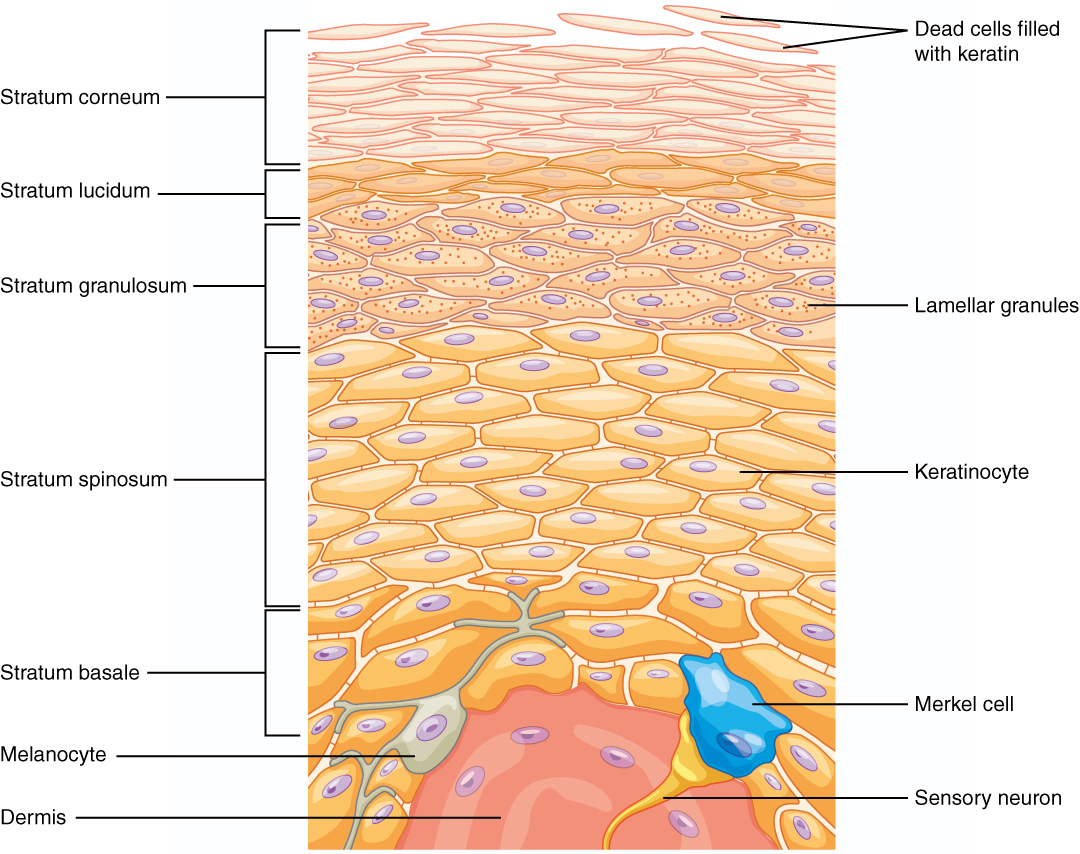
Let’s start at the top.
The Epidermis is comprised of the outermost layers of your skin, and provides the first line of defense.
The most common cell type in the epidermis are keratinocytes. These cells are our protectors, protecting against infections, UV light. They’re produced in the deepest layer of the epidermis (the basal layer), and here they either continue to produce more keratinocytes (stem cells), whereas others start to get pushed outwards towards the surface of the skin.
They next become prickle cells (in the aptly named prickle layer). At this point the cells have a “prickly” appearance, creating a net-like structure. This is where the strength of the epidermis comes from, and acts as protection for the layers below.
The keratinocytes next move into the granular layer, where they start to be flattened. During this process, they secrete fats and proteins into the space between the cells. These fats are what seals your skin against water.
The last stop for the keratinocytes is the corneum layer. At this point, the cells are flat and scaly, densely packed with keratin protein, and generally called squames. After this, the squames flake off, becoming the main component of dust. The whole life cycle of these cells is about a month.
There are a few other cell types that you can find in the epidermis:
- Melanocytes: These cells are primarily responsible for protection against UV rays. They are also dark in colour, and as such, are also the driver for differences in skin colour (people with darker skin have more melanocytes, and people with lighter skin have fewer)
- Langerhans: Langerhans function as part of the immune system, and work to detect infections. It’s thought that langerhans are involved in the development of skin allergies
- Merkel cells: found in the basal layer, these cells help enhance the sensations of touch and hair movement
Fun fact: there is no direct blood supply to the epidermis – the epidermis is dependant on the dermis (coming next) for it’s supply of nutrients and disposal of waste.